GUIDE
How often should you upload type beats
Everyone repeats that you have to publish consistently. Nobody says what consistently means, how long you have to hold it before it counts, or what you do the month consistency collapses — and that is where almost every type beat channel is decided. Here is how to pick a pace, hold it without thinking about it daily, clear a backlog, and restart after a gap.
CONTENTS
THE ESSENTIALS
- A channel is not judged on how many videos it has published, but on how many consecutive weeks it went without a gap.
- You pick your pace on your worst month, never on your best week.
- What holds a pace is not discipline: it is the buffer — two or three releases finished ahead, at all times.
- Producing and publishing are two different activities. Doing both in the same session is the number one reason channels stop.
- Restarting after a gap always costs more than slowing down before one.
01What consistency actually buys
One misconception first: YouTube does not reward consistency as such. There is no seriousness counter somewhere that goes up because you publish on Tuesdays. What consistency produces is far more mundane, and far more solid — three effects with nothing magical about them, and they compound.
The number of attempts
In type beats, you cannot tell in advance which beat will land. The lane you picked, the thumbnail, the reference artist and the release moment interact in ways nobody predicts — including the people selling courses about it. Publishing regularly simply buys more draws. A channel at three releases a week takes a hundred and fifty of them a year; a channel that publishes in waves whenever motivation returns takes thirty, and those thirty are not better ones.
Audience memory
A rapper looking for instrumentals comes back to the same channels. They do not subscribe because your beat is good: they subscribe because they assume there will be more. That assumption is made on what they can see — releases evenly spaced down your channel page. Three videos on the same day followed by six weeks of silence says the exact opposite, whatever the total count.
The catalog effect
Every published video stays a permanent door, indexed on a precise query. That is the fundamental difference between a type beat channel and a social account: what you published eight months ago is still working. A catalog of two hundred videos receives a daily flow that no single release produces — and that flow does not come from the latest videos, it comes from the accumulation.
What exactly you lose when you stop
The downside is undramatic: a stop-start channel is not penalised, it is forgotten. Nothing is taken away from you, you simply stop being shown to people who do not know you yet. That is reversible, but the comeback costs several weeks — the ones it takes for the catalog to look active again, both to the system and to your subscribers.
02Your pace is a production constraint, not a publishing decision
The mistake you see everywhere: choosing a pace based on what you would like to do, then discovering in week three that you never held it. A pace is not a resolution, it is the output rate of a production line — and an output rate cannot exceed an input rate for long. If you finish two beats a week on average, you will not publish five times a week for a year, whatever your starting motivation.
Except that the input rate is irregular by nature. You finish three beats on a Sunday, nothing for ten days, then six in the week a sample pack gets you going again. That is normal, and no planner has ever fixed it. What fixes it is an intermediate part: the buffer.
In practice: you never publish what you have just finished. What you finish joins a queue, and what goes out is whatever has been at the front of that queue for two or three weeks. As long as the queue is not empty, a week with no production is invisible from the outside. It is the only mechanism that makes a pace sustainable without heroic discipline, and it is also what lets you go on holiday without the channel stopping.
How far ahead?
Two weeks of scheduled releases is the useful minimum: it covers one heavy work week or one bout of flu. A month is comfortable and plenty. Beyond that, the buffer becomes stock that ages — your January beats go out in April, with January production and January lanes. An oversized buffer is a symptom of a pace that is too slow, not of good organisation.
03Choosing a pace you can hold
The question is never what the best frequency is. It is: how many finished releases, video and metadata included, can you produce during your worst month of the year — the one where you move house, sit exams, or work runs over. That number is your pace. Everything you produce above it feeds the buffer instead of going out immediately.
| Pace | What it demands each week | What it gives you | What breaks first |
|---|---|---|---|
| 1 release a week | One finished beat, one short session | The minimum for a channel to exist and keep being re-evaluated | Nothing — it is the safest pace, and the slowest to show results |
| 2 to 3 a week | Two or three finished beats, one batch session | The best ratio between effort and how fast you learn what works | Thumbnail and description quality, well before the pace itself |
| 1 a day | Seven finished beats, or a backlog to clear | A lot of draws, and fast feedback on lanes | You, within six weeks — unless the buffer was already full before you started |
| In waves | Nothing for three weeks, everything in the fourth | A feeling of productivity | The audience, who have no reason to come back between two waves |
A word on the "1 a day" row, because it is the one everyone praises: it is not absurd, but it is not decided — it is observed. It is sustainable if you already have a hundred finished beats on a drive, or if your daily output has been real for months. It is not sustainable as a starting point, and a channel going from zero to a daily release almost always stops before the end of the second month — leaving a gap far more visible than if it had never accelerated.
04The session: produce on one side, publish on the other
The expensive move is not the production, it is the crossing from production to publishing: rendering the video, making the thumbnail, writing the title, the description, the tags, picking the date. Done beat by beat, that crossing is a tax paid on every release, and it is exactly where channels stop — not from running out of ideas, but from being worn down by repeated admin. Done once for a whole batch, it is an afternoon a month.
- 1Gather, with nothing else openPut the finished masters in one folder, named once and for good. Nothing that follows should send you back into your DAW: if a beat is not finished, it does not enter the session. Mixing "let me finish this one part" with "let me publish" is the most reliable way to do neither.
- 2Render the videos in one passSame visual template, same export settings, every beat back to back. It is the most mechanical part of the session and the easiest to hand to a machine — the settings themselves (resolution, bitrate, frame rate, looping) are covered in the video guide.
- 3Write the metadata in a column, not one at a timeTitle, description, tags: one column per field, one row per beat, in a spreadsheet or in whatever will publish them. Writing ten titles in a row from the same template takes a quarter of the time of writing a title ten times in the middle of ten uploads, and the result is far more consistent.
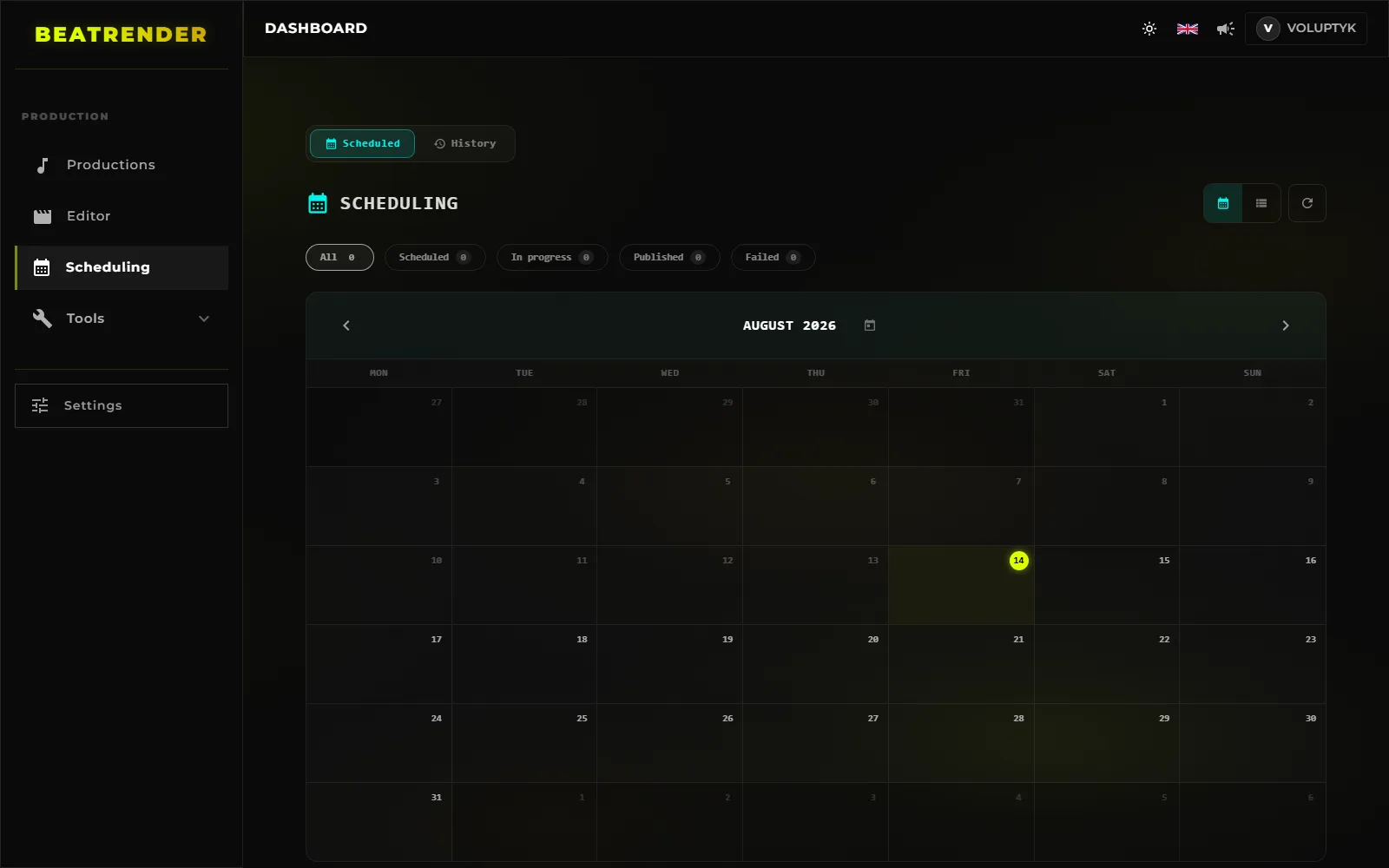
- 4Schedule, then forgetAssign dates across the whole batch at once, respecting the spacing you chose. From there, the channel publishes without you. It is the one step whose benefit is invisible at the time and decisive three weeks later.
- 5Check once, at the endOne review pass over the whole batch: no overlapping dates, no description still carrying the previous beat's variable, every video pending rather than public. Checking after each beat costs ten times more and does not find more mistakes.
05Where to place releases in the week
Once the pace is chosen, the releases still have to be spread out. The rule is simpler than it looks: the spacing must be constant. Three releases a week means Monday, Wednesday, Friday — not three videos on Saturday. A batch published on one day cannibalises itself, occupies your subscribers' feed once, and leaves six days of silence behind it.
The day
There is no universal best day, and articles that name one are extrapolating from audiences that are not yours. What matters is that the day stays the same from week to week: that is what makes a channel predictable for the people already following it. Choose, write it down, and do not reopen the question until you have numbers.
The time, and the timezone that counts
The one non-negotiable point is to think in your viewers' timezone rather than your own: a type beat channel run from Europe very often has a North American audience, and releasing at 9am local time means publishing in the middle of the night for the people who buy. YouTube Studio gives the exact answer for your channel, and the bulk uploading guide says where to read it.
The rest is a question of consistency rather than optimisation. One slot beats a good slot moved every three weeks: as long as you keep shifting the time, no comparison between two videos means anything, because two variables moved. Hold the same slot for eight weeks, then judge.
06Clearing a backlog without flooding the channel
Plenty of producers arrive with forty or a hundred finished beats on a drive, never published. The temptation is to release everything to catch up. It is the worst possible use of a catalog: the hundred videos fight over the same audience on the same day, none of them gets time to be tested, and the next day the channel is back to zero releases — with a catalog that now looks abandoned on top of it.
The rule: one extra release, not double
- 1.Sort the backlog into three piles: still good, acceptable, and not worth a video. The third pile never goes out — a filler beat costs exactly the same publishing work as a good one.
- 2.Set the normal pace first, the one you will hold after the backlog. Everything else is structured around it.
- 3.Clear the stock by adding one release a week to that pace, not by doubling it. Twenty backlog beats at one extra per week is five extra months of coverage — that is an advantage, not a delay.
- 4.Alternate: one backlog release, one recent release. It stops a visitor landing on three months of two-year-old production, and it lets you measure whether the older material still interests anyone.
Reuploading a beat you already released
The question comes up as soon as a beat does nothing on its first release. Reposting it identically — same video, same title, same description — is a reupload: it adds nothing, it puts two pages of your own channel in competition on the same query, and it is exactly what platforms watch for when they look for repetitive content.
A second release only makes sense if something genuinely changed: a new reference artist that became relevant since, a video redone, a mix reworked. In that case treat it as a new release and take the old one out of circulation — set to unlisted rather than deleted, so the links pointing at it keep working. Two videos of the same beat coexisting means you are competing with yourself, and it is the one case where the answer is flatly no. The guide on reuploading a type beat walks through the five possible moves, from cheapest to most expensive, and what each one erases.
07What breaks a pace
Paces almost never stop on a disaster. They erode, and always in the same places:
- Publishing what you just finished. With no buffer, the first thin week is a visible gap — and the first gap is what licenses the second.
- Doing the video and metadata beat by beat. The cost is bearable the first time and unbearable the thirtieth: it is the most common reason channels stop, far ahead of running out of ideas.
- Picking the pace of your best month. It is unsustainable ten months out of twelve, and the failure gets read as a lack of seriousness when it is a sizing error.
- Changing lane, template or slot every three weeks. Each change resets the learning counter: six months later you have six one-month experiments instead of one six-month experiment.
- Catching up. After a missed week, publishing double the next one recovers nothing and drains the buffer — that is the mechanism that turns a one-week gap into a permanent stop.
- Merging production and publishing into the same session. Both compete for the same hours, and it is always publishing that gets dropped.
08Restarting after a gap
Everyone stops at some point. The good news is that a type beat channel does not die from a two-month gap: the catalog keeps taking views, subscribers stay, and nothing is removed. What disappeared is being shown to people who do not know you — and that comes back, provided you avoid the classic mistake.
- 1.Do not compensate. Restart at the previous pace, or below it. Coming back at four releases a week after three months off is a second interruption already scheduled.
- 2.Build the buffer before restarting, not after. Three releases finished and scheduled before the first one goes out: that is what means the comeback does not have to work on the first try.
- 3.Do not explain yourself. A video announcing the channel is back only interests subscribers who never left. A comeback is read in the release grid, not in an announcement.
- 4.Count in weeks, not in videos. Eight weeks without a gap puts a channel back in circulation; eight videos published in ten days does not.
09Measuring whether the pace works
The reflex is to look at the latest video's views. It is the least informative measure available: on a type beat catalog the spread is enormous, and a 40-view video followed by a 4,000-view one says nothing about your pace — it says you hit a lane. What can be measured about a pace is measured in weeks and in medians.
The five numbers that describe a pace
- —The median of the last ten releases, not the best one. The best measures your luck, the median measures your method.
- —The number of consecutive weeks without a gap. It is the only number that describes your consistency, and it appears in no interface — write it down yourself.
- —The share of the catalog taking views this month. A healthy channel keeps its back catalog alive; a channel where only the last three videos move has no catalog effect yet.
- —The gap between the median and the best video. If it narrows over the months, your template and your lanes are genuinely improving.
- —Sales counted per week, never per video. A buyer often finds a beat weeks after release: attributing it to one specific video is misleading almost every time.
When to decide to change something
One rule about horizon, finally: change nothing for eight weeks. A pace takes weeks to produce its effects and the first month of data is dominated by noise. If you adjust every week, you are no longer measuring your channel, you are measuring your adjustments.
10What automates, and what does not
What holds no decision at all
Take the session described above and look at what each step actually demands. Rendering the video, applying a title and description template, spreading dates across a calendar, pushing to the platform: those are decision-free tasks, identical from one beat to the next, and the only argument for doing them by hand is knowing how — which stays useful the day a tool fails you.
What holds a judgement
What does not automate is everything containing a judgement: which lane to aim at, which backlog beats do not deserve to go out, when to drop a reference artist that is not catching, and when to slow down because the buffer is draining. A fully automated channel publishing filler at the exact same time every Tuesday is not a consistent channel: it is a gap that takes longer to become visible.
11The session checklist
- The pace is written down somewhere, with the day and time of every slot.
- The buffer covers at least two weeks of releases already scheduled.
- Every beat in the batch is finished: no going back into the DAW during the session.
- The batch videos are rendered with the same template and the same export settings.
- Title, description and tags follow the same template, variables updated per beat.
- Dates are spaced by the interval you chose, with no two releases on the same day.
- A single review pass over the whole batch was done before closing the session.
- The date the buffer runs out is written down: it is what triggers the next session.
None of this requires gear, an audience or money. These are decisions made once — a pace, a spacing, a buffer, a session — that make the hours you spend producing count for something. The hard part is not making them: it is not reopening them every three weeks.
READ NEXT
- 10 MIN READHow to make a type beat videoFormats, resolution, looping, loudness, thumbnails and tags: the complete guide to turning a type beat into a YouTube video, then cutting it for 9:16.
- 10 MIN READHow to publish beats to BeatStars automaticallyPrepare your files, fill in the metadata that sells, handle licences and cover art, publish in batches and sync with YouTube and TikTok.
- 12 MIN READWhere to sell your beats: BeatStars, Airbit, TrakTrain or your own storeCommissions, payouts, licences and lock-in: what actually separates BeatStars, Airbit, TrakTrain and your own store — plus the maths that settles it.
- 10 MIN READHow to upload beats to YouTube in bulkPrepare a batch, upload several beats at once, schedule releases to the hour and keep metadata consistent across an entire catalog.
- 11 MIN READHow to upload beats: what to settle before you clickAudio format, loudness, cover art, metadata, rights and samples: everything to settle before you upload a beat, on any platform.
- 9 MIN READTitle, description and tag templatesOne title template, one description block and a reusable tag list for every release — plus the method that stops you rewriting them on every upload.
- 12 MIN READPromoting your beats on TikTok and YouTube ShortsWhere to cut the thirty seconds, which export settings, what to write in the caption and where the buy link really lives: short-form for beatmakers.
- 17 MIN READBuilding a type beat YouTube channelLane, channel identity, playlists, thumbnails, Shorts, revenue and analytics: how to build a type beat YouTube channel that still runs a year from now.
- 15 MIN READBeat licensing and pricing: what you actually sellMP3, WAV, trackout, unlimited, exclusive: what each tier really allows, how to set your prices, and what the contract has to say in plain words.
- 14 MIN READSplitting a beat between producersWho owns what when a beat is co-produced: usual splits, BeatStars payouts, YouTube revenue, samples, and the written agreement that prevents a dispute.
- 12 MIN READHow to promote your BeatStars beats on YouTubeWhere the buy link goes, what belongs in the two visible lines of a description, what the pinned comment is for, and how to find out which video actually sold.
- 14 MIN READConnecting your accounts to an upload toolPassword, OAuth or browser extension: what an upload tool really gets on your accounts, what it cannot do, and how to take the access back.
- 18 MIN READHow to make a type beat thumbnail that gets clicksDesign for the phone tile, three elements and never four, what the artist photo costs, and the one number that tells you whether a thumbnail works.
- 15 MIN READHow to audit a type beat channel when the views are not comingYour type beats get no views? The eight checks to run in YouTube Studio, in order, to find the link that breaks — and what to fix first.
- 15 MIN READProducer name and branding: how a beatmaker gets found by name, on every platformA producer name that can be dictated and typed, the producer tag, the “prod.” credit, one identity on YouTube, BeatStars and TikTok — and what a rename costs.
- 11 MIN READAutomating type beat uploads: one beat in, published everywhereThe eight stages of a release, what is decided once, where a publishing pipeline gets it wrong, and the five-move check to run before you trust it.
- 12 MIN READAI tools in type beat production: what they do, what they miss, what they will never decideWhat AI measures better than you, what it only drafts, what it will never decide — and what its involvement changes about what you can sell.
- 12 MIN READReuploading a type beat: when to re-release it, when to retouch it, when to leave it aloneA beat that went nowhere: leave it, retouch it, retitle it or re-release it. What each move keeps, what it erases, and when reuploading is off the table.
- 12 MIN READChoosing the reference artist for a type beat: the sound, the demand and the roomHow to choose the reference artist for a type beat: does it sound like them, is anyone searching, is there room left. A method that needs no paid tool.
- 10 MIN READRecreating the look of a type beat video that works, without copying the channelStart from the visual of a type beat video that sells: pick the reference, break the look down, keep the layout without the brand, make it your template.
- 12 MIN READJust Drop The Beat vs BeatRender: which one to publish your type beats withVideo, thumbnail, titles, platforms, account connection and pricing: what actually separates Just Drop The Beat and BeatRender, and which one to publish with.